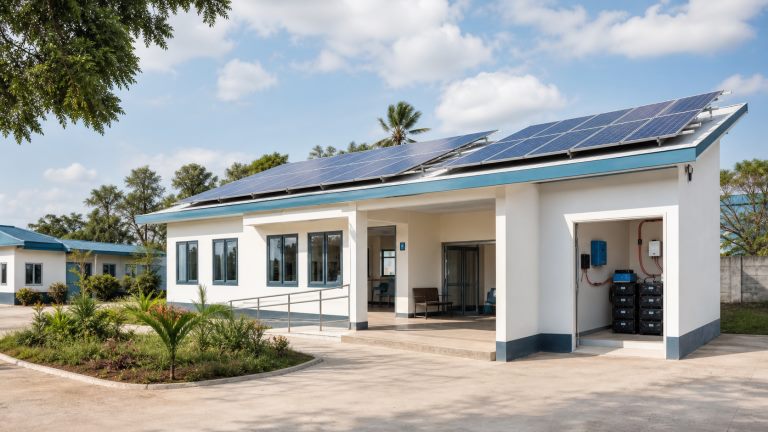

Healthy communities need more than buildings and equipment. They need reliable services around those facilities: clean water, stable power, safe storage, lighting, communication, and maintenance. Solar energy can support many of these needs when systems are designed around real community use.
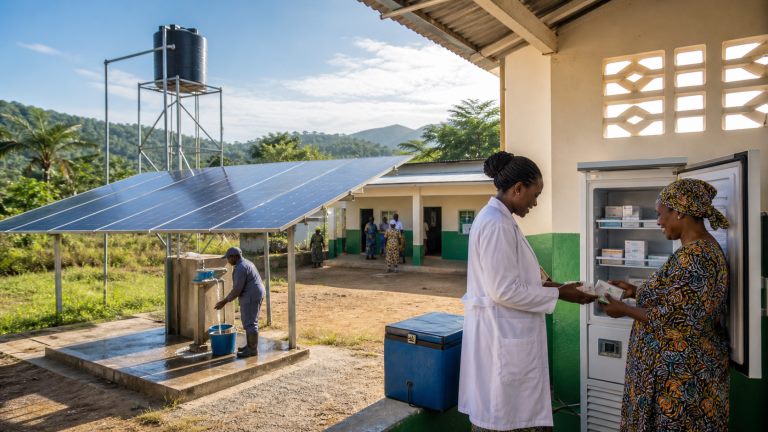
Two strong examples are solar water pumping and healthcare cold chain. Together, they show how energy infrastructure can improve daily life and strengthen public health services.
Clean water needs reliable power
Water systems often fail when pumping depends on unstable electricity or difficult fuel supply. Solar water pumping can reduce that risk by using daytime energy to move water into storage tanks for later use.
For clinics, schools, farms, and communities, this can support hygiene, cleaning, irrigation, drinking water access, and general service reliability. A good system considers water demand, pump depth, storage capacity, pipe layout, security, and maintenance access.
Cold chain protects sensitive supplies
Some medical supplies, vaccines, reagents, and samples must remain within safe temperature ranges. If refrigeration fails, the loss can be expensive and harmful to service delivery. Reliable power is therefore a cold-chain requirement, not an optional extra.
Solar systems can support refrigeration when designed with the right battery autonomy, efficient equipment, temperature monitoring, and backup planning. The goal is consistent storage, even during outages or remote operations.
Integration matters
Water pumping and cold chain should not be designed in isolation. A community health compound may also need lighting, security systems, communication devices, laboratory equipment, and computer access. Integrating these needs helps avoid undersized systems and overloaded circuits.
It also improves maintenance planning. Technicians can inspect energy generation, storage, pumps, controls, refrigeration, wiring, and protection devices as one operating environment.
Resilience is practical, not abstract
Community resilience is built through ordinary systems that keep working: water that reaches the tank, refrigerators that hold temperature, lights that stay on, and equipment that remains safe to use.
For HenHes, renewable energy and health technology belong together because communities experience them together. When infrastructure is planned well, it supports better service, lower downtime, and stronger confidence in local institutions.